
Searching Webster County Civil Dockets
The statewide Nebraska JUSTICE One-Time Court Case Search is the online starting point for a Webster civil docket. There is no separate Webster portal. Accept the terms and pay the one-time fee of $17. You can then pull up to 30 results. A party-name search can be narrowed by case type, case year, or birth-date information. The paid result stays open for three calendar days. A recent entry can lag the court's overnight update cycle. So give brand-new filings time to appear.
Before you open a result, confirm the court level and case category. Two different matters can share one civil party name. Compare the court, case number, filing year, caption, role labels, and subtype. The register of actions is the dated court sequence. Use it to spot a complaint, petition, service return, motion, order, judgment, or later enforcement event. Then ask the clerk for a copy of any document.
- Open JUSTICE, accept the terms, and enter the party name or complete case number when available.
- Use a civil category or case year only as needed to reduce a broad result set.
- Confirm whether the Webster matter is in County Court or Webster District Court before relying on the case summary.
- Read the register from the filing through the latest entry, then check any image link that is public and available.
- For a filed or certified copy, give the relevant clerk the case number, document name, and document date.
Note: An online search result is case information only. It does not guarantee that every document, financial detail, or protected attachment is public.
Webster Civil Search Filters
JUSTICE runs them through one public search entry. The categories span civil, criminal, traffic, juvenile, probate, and other Nebraska trial-court matters. The one-time landing page shows no civil-only Webster form. Its public route works from the party name. Optional narrowing details sit in the official search instructions. A subscriber account adds filters for county, court type, civil subtype, judge, and attorney. Those extra filters help in one way. They separate a County Court civil case from a District Court civil case.
The state also describes separate subscriber searches for a judgment date and court case number. Neither is a public document request. When nothing comes back, check spelling, case year, and court level. A no-result can mean a delayed entry, a restricted record, an older file, or a typo in the search detail. If the record question will not resolve online, the clerk is the next route.
| Field or control | One-time route | Subscriber route |
|---|---|---|
| Party name | Required for a name search; not a witness search | Available with other criteria |
| Birth date, type, year | Optional narrowing details | Available with broader filters |
| Webster and court type | Confirm from returned case information | County and County Court/District Court filters when offered |
| Judgment date or case number | Not exposed as a free public form | Separate paid subscriber searches |
Inside a Webster County Civil Docket
A civil register is the case chronology, not a summary of who won. The header identifies the court and county. It also lists case type or subtype, caption, filing information, and status context. Party roles may read plaintiff and defendant. They may also be petitioner and respondent, or estate and ward in specialized proceedings. From there, the dated register records each filing and court action in turn. Financial receipts and payments sit in their own block. They stay separate from the order or judgment that resolved the legal issue.
| Case number and header | The court-assigned identifier, court/county, caption, type or subtype, filing details, judge, and status context when available. No Webster-specific number format is published. |
|---|---|
| Party and attorney fields | Party roles and representation fields where the record displays them. |
| Register of actions | The date, action, and document sequence, including filings, service, motions, orders, settings, and outcome entries. |
| Images | Linked nonconfidential documents may be available; an image ID is not a promise that every filing can be opened. |
| Financial information | Receipt, type, date, purpose, and amount; payment fields can be separate from the disposition. |
| Judgment activity | Judgment, default judgment, dismissal, satisfaction, or later enforcement entries when recorded. |
The official civil register demonstration shows the layout of the state's register fields. It is a sanitized example, not a live Webster case.
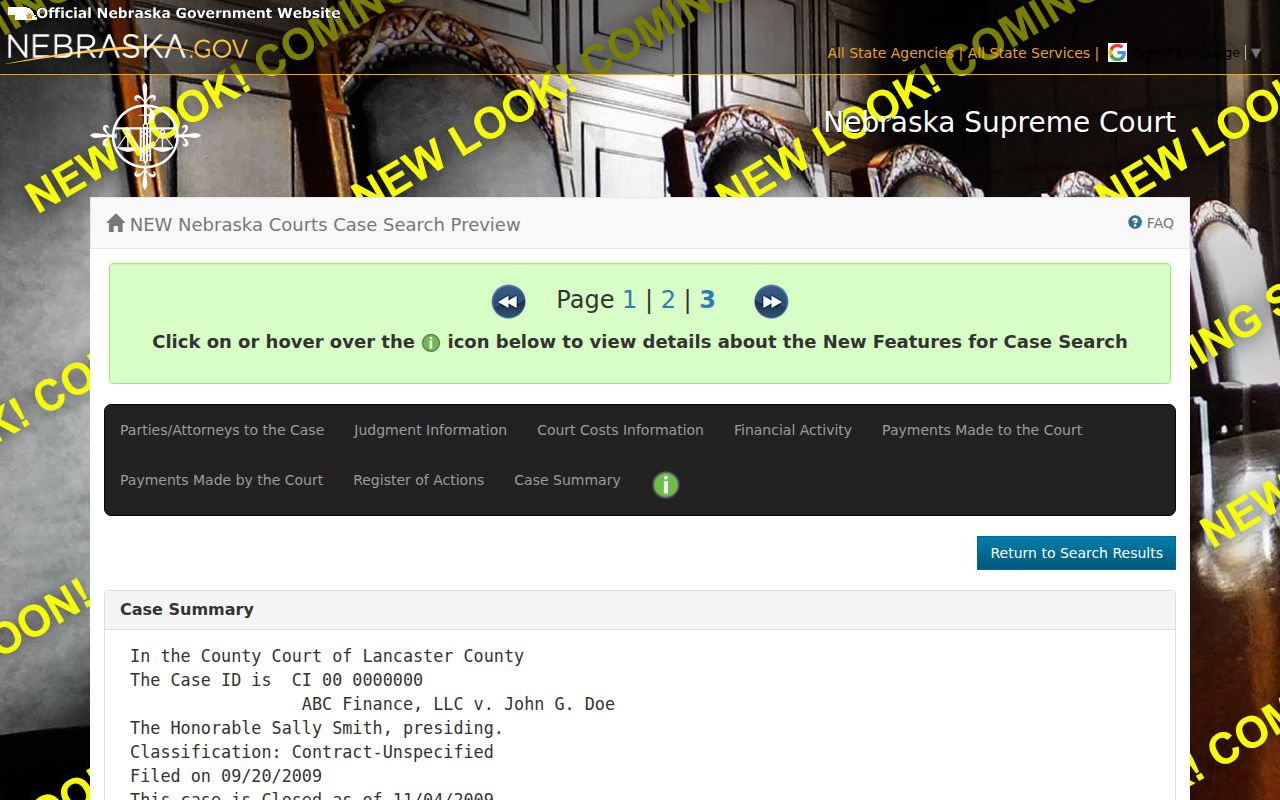
Read the register as an ordered event list. A filing, service event, motion, order, and judgment entry can each answer a different question about the case.
Webster Civil Limits Compared
Webster civil dockets split by jurisdiction. The current state-published County Court civil limit is $70,000 or less. The small-claims limit is $7,500 or less. The local Webster County Court page still displays $57,000 for civil and $3,900 for small claims. Those figures are stale. Use the current state number. Confirm the proper filing court with the clerk whenever the amount or case type sits close to a boundary.
County Court also handles Webster small claims, probate, guardianship, conservatorship, and adoption. Matters above the County Court limit belong to Webster District Court. It is the general-jurisdiction civil court. District civil, domestic-relations, protection-order, and other district proceedings land there too. The statewide JUSTICE entry point does not erase that split. The court named in the case header tells you which clerk keeps the civil register.
| Webster civil route | Custodian | Current category |
|---|---|---|
| County civil | Jolene Duffy, County Court Clerk Magistrate | Civil matters at $70,000 or less |
| Small claims | Jolene Duffy | $7,500 or less |
| Probate and related matters | Jolene Duffy | County Court specialized categories; access may be limited |
| District civil and domestic relations | Abbey Haskins-Harig, District Court Clerk | General-jurisdiction and District Court categories |
Civil Case Types on the Docket
Webster County Court civil records cover standard county-court civil matters and small claims. Probate, guardianship, conservatorship, and adoption sit there too. Webster District Court holds district civil, domestic-relations, protection-order, and other district proceedings. A city or village can keep its own notices, ordinances, or administrative files. Those are not a substitute for a Webster court register. There is no separate justice-of-the-peace or municipal civil docket in the county.
- County Court civil matters within the current state-published jurisdictional limit.
- Small claims at or below the current $7,500 threshold.
- Probate, guardianship, conservatorship, and adoption matters in County Court, subject to specialized access rules.
- District Court civil matters above the County Court limit.
- District Court domestic-relations and protection-order proceedings.
A local government may be named in a case. That alone does not create a separate city docket. Match the amount, category, and court shown in the record rather than assuming a city office keeps the court case.
Webster Civil Register Sequence
A Webster County civil docket tells a story in stages. The complaint or petition opens it. Summons, service return, an answer, motions, orders, and a trial setting usually come next. Enforcement may follow the final ruling. Each entry means something different. A notice issued only proves notice went out, never that the recipient showed up. A motion asks the judge to act; an order is the judge actually acting. A result and a request may sit on separate dates in the docket. That gap matters.
Zero in on the judgment or dismissal entry itself. A default judgment means the other side never responded or appeared. A nonsuit ends the claim under the governing procedure. A satisfaction records that a judgment has been paid off. These labels only go so far. For the true legal effect, read the court's own record and order.
- Service return
- A filed record of service activity, often following a summons or citation.
- Default judgment
- A judgment entered after a required response or appearance did not occur.
- Garnishment
- A post-judgment collection process that can produce later register entries.
- Satisfaction
- An entry recording that a judgment has been satisfied.
Civil Docket Settings and Hearings
A civil setting is one scheduled court event, not the whole case. For Webster County Court dates, the public statewide calendar searches by date or last name. It even flags that its data can lag. Two limits stand out. It does not take a case number. And Webster District Court is missing from its selector entirely. A District civil or domestic-relations hearing date should be checked against the register. Use the latest notice or order too, and confirm with the District clerk directly.
Always read the newest entry first. An earlier date becomes history once a continuance appears. JUSTICE may list a setting the public calendar leaves off, so an omission proves nothing about whether a hearing exists. County Court lookup is where the statewide calendar genuinely helps with future dates. Either way, when you must appear at a precise time or place, the clerk is the confirmation point that counts.
Note: Confirm any Webster civil docket setting from the latest register entry. Check with the clerk too, especially after a reset or continuance.
Webster Post-Judgment Entries
A Webster County civil docket does not always go quiet once judgment enters. Later entries can pile up for years. The pattern runs from complaint and service to a motion or default judgment, and then on to garnishment, a continuing lien, release of garnishment, and satisfaction. A register like that still cannot replace the order itself, because the docket keeps recording activity long after the court's decision.
Money entries deserve their own careful read. A receipt or payment table names a payment, its date, purpose, and amount. What it does not tell you is the legal disposition, whether the judgment was released, or whether every obligation was met. Set the financial block beside the register and the judgment-related entries, and never treat a payment as a stand-in for what the court actually ordered.
The official judgment-record demonstration shows the sample page that follows.
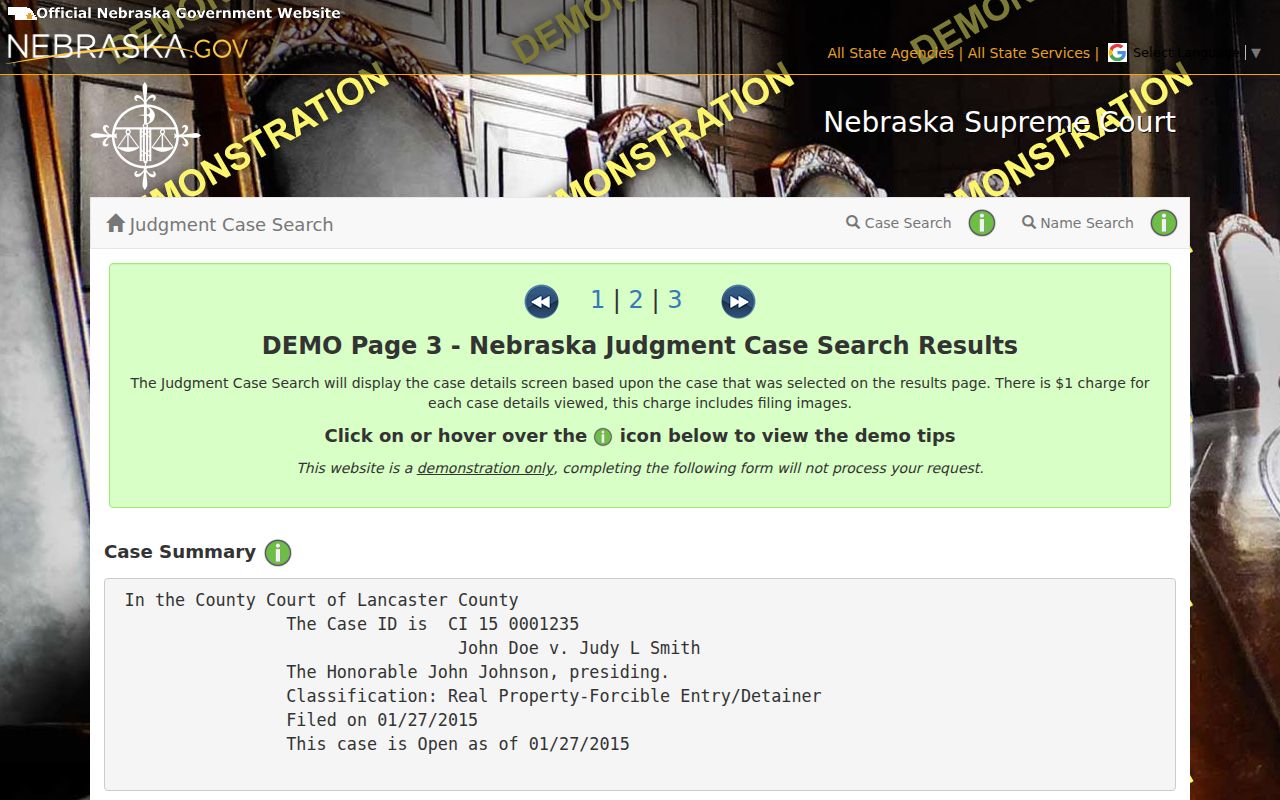
The judgment sample shows the split clearly. Procedural register, judgment entry, and the financial records that follow each answer a different question.
Civil Docket Access Rules
Public does not mean unlimited. A Webster civil docket sits inside the Nebraska Public Records Act framework for examining and copying records. Nebraska court rules govern court-record access specifically. Guardianship, probate, adoption, personal financial appendices, personal identifiers, and sealed filings can all be restricted or redacted. If an image is missing, ask the clerk before assuming the document was never filed.
Key Rules:
Neb. Ct. R. §1-803 gives the public equal access to court-record information except for listed restrictions.
Neb. Rev. Stat. §84-712 sets the public-record examination and copy framework.
Neb. Rev. Stat. §84-712.01 includes county and city computer files within the public-record definition.
Neb. Ct. R. §2-215 permits public viewing while excluding confidential and sealed material.
Put the basics in writing under §84-712: the court, the case, the document, the date, and whether you want to inspect or copy. Once the request actually arrives, the custodian has four business days under the statute to provide access or copies, deny it in writing, or explain the earliest practicable date if the request is unusually difficult or extensive.
Webster Civil Clerk Routes
Jolene Duffy serves as Webster County Court Clerk Magistrate. Her office handles County Court civil, small claims, probate, guardianship, conservatorship, and adoption records. For District civil and domestic-relations filings, Abbey Haskins-Harig is the Webster District Court Clerk. Both clerk offices sit in the same building. The address is 621 North Cedar Street, Red Cloud, NE 68970. District Court also takes mail at P.O. Box 250, Red Cloud, NE 68970. To reach the County Court clerk by phone, call 402-746-2777 and choose option 4. The District Court line is 402-746-2716.
County Court civil records
Use this route for County Court civil, small claims, probate, and related specialized case records.
402-746-2777, option 4
District Court civil records
Use this route for district civil, domestic-relations, protection-order, and other District Court records.
402-746-2716
When JUSTICE lacks the document you need, the courthouse terminal is free. Or you can request a plain or certified copy through CC 3:29. Mail, phone, fax, email, and a written public-record request all work as documented routes. County Court fax is 402-746-2771, with published email jolene.duffy@nejudicial.gov. District Court fax is 402-746-2710, and its published email is abbey.harig@nejudicial.gov. Name the case number, case name, document, and date. Webster civil and small-claims records moved onto JUSTICE in January 2001. Older material may take clerk or archival digging.
The current Judicial Branch fee schedule carries today's civil and small-claims thresholds. It backs the table that appears next.
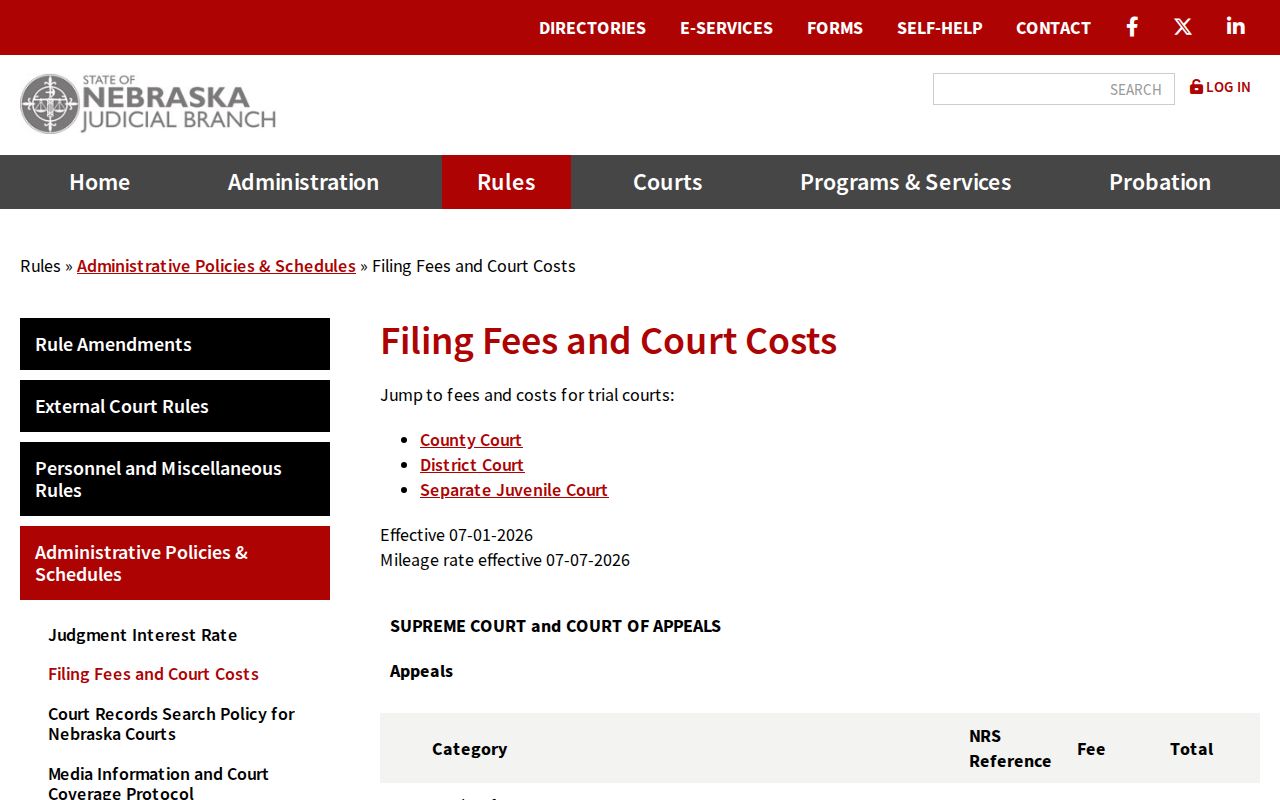
The fee-schedule image clears up a common trap. It separates the current statewide limits from the older figures still posted on the local Webster County Court page.